Most employers already know sickness absence is expensive. What is easier to miss is that the real problem is not always the total number of days lost. Sometimes it is the timing, the role, and the knock-on effect across the rest of the business.
When the wrong person is off at the wrong time, absence stops being an HR metric and starts becoming an operational problem. A delayed decision, a stretched team, an overloaded manager, a missed deadline, a client issue. This is where absence becomes more than a wellbeing topic. It becomes a business continuity issue.
The latest UK data shows that 148.8 million working days were lost to sickness absence in 2025, with a sickness absence rate of 2.0% and an average of 4.4 days lost per worker across the year. Those levels remained above pre-pandemic patterns, even though the rate itself was unchanged from 2024.
At the same time, Health and Safety Executive data shows that 40.1 million working days were lost in 2024/25 due to work-related ill health and non-fatal workplace injuries. Within that total, stress, depression or anxiety accounted for 22.1 million lost days, while musculoskeletal disorders accounted for 7.1 million.
That matters because musculoskeletal issues are often treated as routine, when in reality they can be highly disruptive. HSE reports that the average time off per case was 14.0 working days for work-related musculoskeletal disorders and 22.9 days for stress, depression or anxiety. One unresolved case in a key role can create pressure well beyond the individual absence itself.
This is where many wellbeing conversations become too vague to be useful. Apps, awareness days and broad messaging may have their place, but they do not automatically address the real causes of repeated strain, physical discomfort, workload pressure, or delayed support. That is not a criticism of wellbeing itself. It is a reminder that employers need to look beyond surface-level activity and ask what is actually reducing risk.
CIPD’s Health and Wellbeing at Work 2025 report reinforces that point. It found that average employee absence rose to 9.4 days per employee per year in its employer survey, up from 7.8 in 2023 and 5.8 in 2022. The same report found that mental ill health was the leading cause of long-term absence, while musculoskeletal injuries remained one of the main causes of long-term absence.
It is important to interpret these figures carefully. ONS, HSE and CIPD are not measuring exactly the same thing, so they should not be merged as if they are directly comparable. But read together, they point in the same direction: sickness absence remains a real business issue, and musculoskeletal and mental health-related problems continue to take up a significant share of lost time.

So what should employers do with that information?
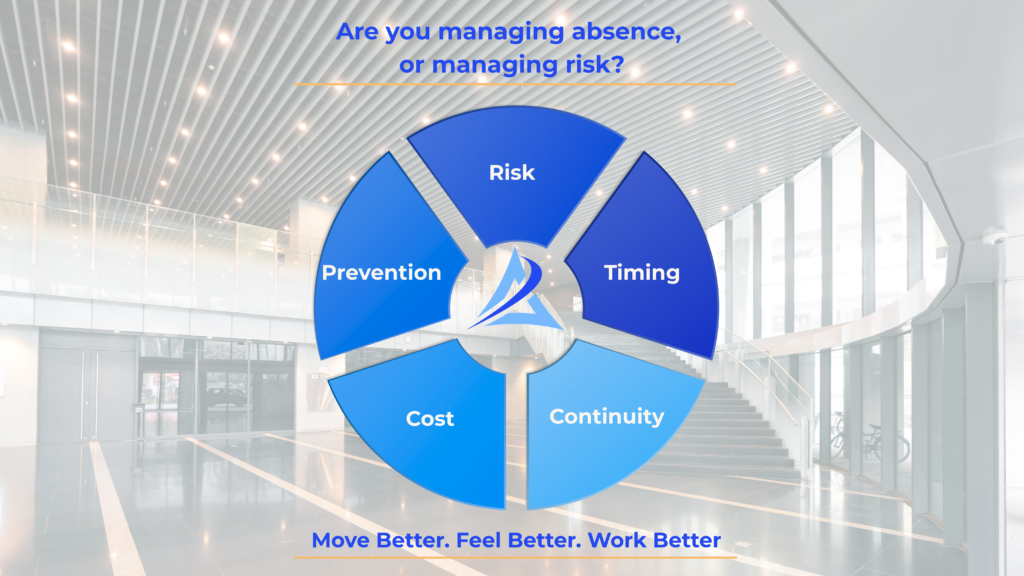
The first step is to stop thinking about absence only when someone is already off sick. By that point, the disruption has often already started. The more useful question is whether support is available early enough to pick up discomfort, strain, fatigue, ergonomic issues, or early warning signs before they become longer and more disruptive periods of absence.
The second step is to accept that prevention is not just about reducing a number on a report. It is about protecting continuity. It is about helping people stay comfortable, functional and supported at work, especially in roles where pressure, responsibility and workload have a wider impact on the rest of the team.
The third step is to be realistic. No single intervention can guarantee lower absence, and no responsible provider should claim otherwise. But the evidence does support a more targeted, earlier and more structured approach to workforce health, particularly where musculoskeletal strain and work-related pressure are concerned.
For business owners and HR leaders, that is the real opportunity. Not to chase perfect absence figures, but to build a workplace approach that is more credible, more practical and more preventive than generic wellbeing alone. Because the hidden cost of sickness absence is not always the number itself. Sometimes it is what happens around it.
References
Office for National Statistics. Sickness absence in the UK labour market: 2025. Published 30 April 2026.
Health and Safety Executive. Working days lost in Great Britain.
CIPD. Health and Wellbeing at Work 2025.
People Management. Almost 150 million working days lost to sickness last year, ONS study finds. Published 4 May 2026.