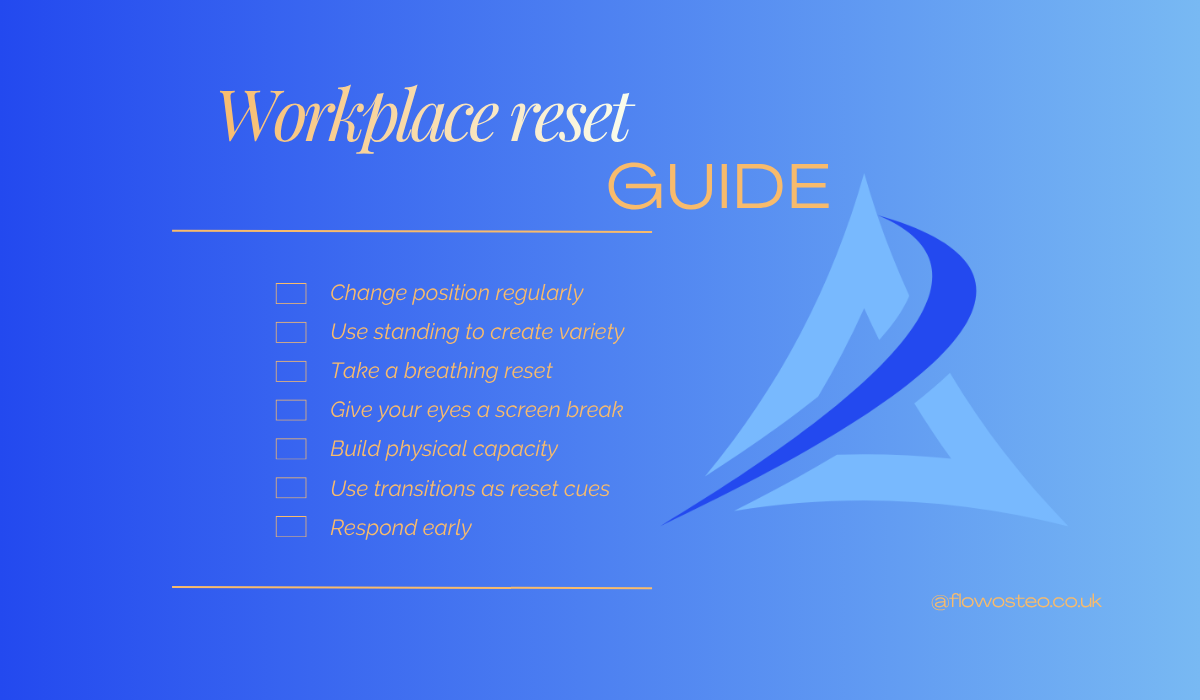
Seven ways to break up a static working day
Musculoskeletal discomfort does not always begin with a sudden injury. Sometimes it builds as the same positions and demands are repeated until they become harder for your body to tolerate comfortably.
Office work can involve hours of sitting, screen use and concentration with very little physical variation. There may be no single moment when anything “went wrong”, yet neck tension or lower-back discomfort can still develop gradually.
Sitting is only one part of the picture. How long you remain still, how often you move, your working setup and your current physical capacity can all influence how you feel. A helpful workplace reset focuses on variation, movement and physical capacity.

Avoid waiting for stiffness or discomfort before moving. Change between supported sitting, standing and short walks throughout the working day.
Connect these changes to your existing routine: stand during a short call, sit for detailed work and walk between meetings when possible. Research suggests that static sitting and fewer breaks may be more relevant to lower-back pain than total sitting time alone.
2. Use standing to create variety
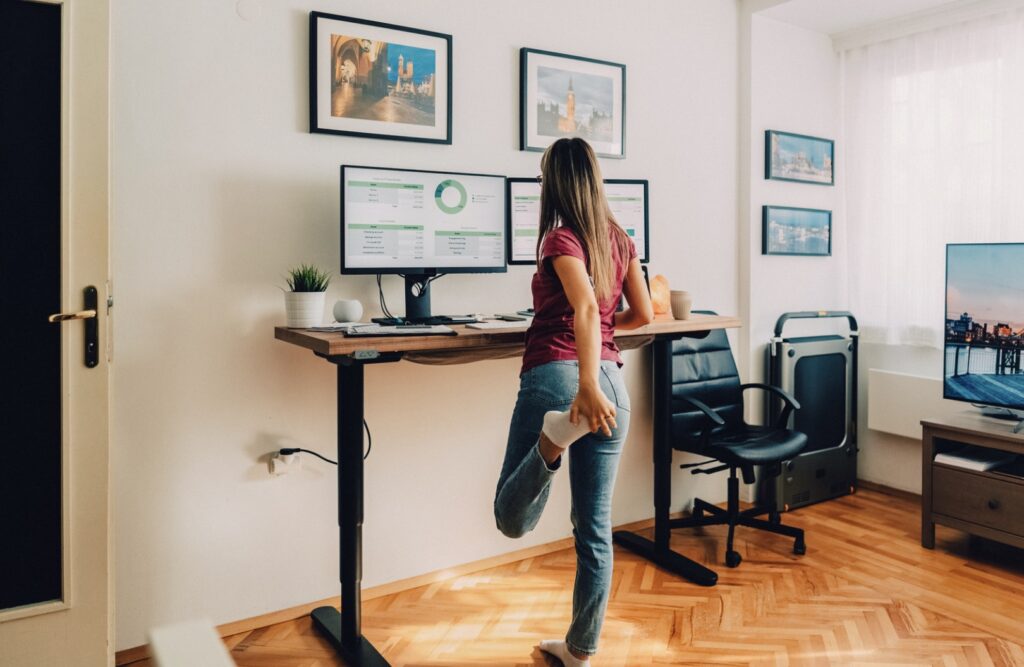
A sit–stand desk allows you to vary your working position throughout the day. Use standing for short calls, reading or brief online meetings, then adjust the desk again as your task and comfort change.
A systematic review of 12 studies found that sit–stand desk interventions reduced workplace sedentary time by an average of 73 minutes per day after nine weeks, 88 minutes after three months, 80.8 minutes after six months and 48 minutes after 12 months. The strongest evidence supports their use for breaking up prolonged sitting.
Set the desk at a comfortable height for both sitting and standing, keeping your shoulders relaxed, elbows close to your sides and keyboard and mouse within easy reach. Alternate between these positions according to your task and comfort, adding short walks whenever possible. The value of a sit–stand desk comes from making healthy variation easier throughout the working day.
Focused work and busy schedules can make breathing feel shallow or rushed. Pause for a few minutes and breathe slowly and comfortably, allowing each breath to settle without forcing it.
Take a few minutes between demanding tasks to slow your breathing and settle into a comfortable rhythm. A short breathing practice can provide a practical transition between meetings, periods of concentrated work and other demanding tasks.

4. Give your eyes a screen break
Screen-based work reduces blinking and keeps your eyes focused at the same close distance for prolonged periods, which can contribute to dryness, blurred vision and eye strain.
Look away from the screen periodically and focus on something farther away. Blink slowly and fully a few times, then use the opportunity to relax your jaw, move your neck and let your shoulders settle. Choose a break frequency that fits your work and respond early when your eyes begin to feel dry, tired or irritated.
5. Build physical capacity
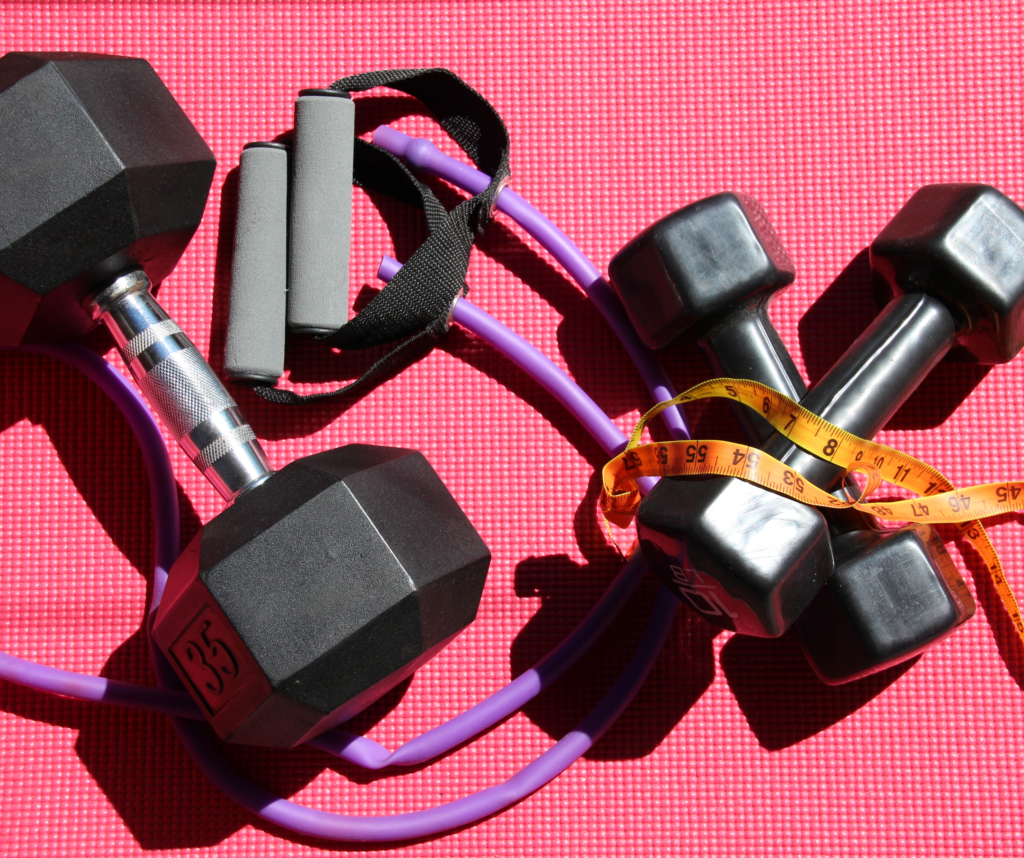
Movement breaks help interrupt prolonged, static work. Regular exercise serves a different purpose: it can improve strength, flexibility and balance, giving your body greater physical capacity for everyday movement.
A 2024 randomised controlled study followed 70 office workers with musculoskeletal discomfort. Participants who completed a supervised six-month programme combining strength, flexibility and balance exercises improved their cervical, handgrip, back and leg strength by 10.3–27.1%, while the control group showed no meaningful change. Improvements were also recorded in flexibility, balance and reported musculoskeletal discomfort. The practical message is that movement breaks and progressive exercise play different roles: breaks create variation, while exercise builds capacity.
6. Use transitions as reset cues
A reset is easier to maintain when it is linked to something you already do. Use natural transitions in your working day as reminders to move, breathe or look away from the screen.
Good opportunities include:
- After an online meeting
- Before starting a new task
- While waiting for a document to load
- When making a drink
- Before and after lunch
- After completing a period of concentrated work
Keep each reset simple. A brief walk, a change of position or a few slow breaths is easier to repeat than a complicated routine that interrupts your work.
7. Respond early
Recurring discomfort is worth addressing, even when it is mild. Consider what happens before your symptoms develop:
- How long have you remained still?
- Which tasks increase your discomfort?
- Does changing position help?
- Are you taking genuine movement breaks?
- Does your workstation support the task?
- Could appropriate strengthening improve your capacity?
Small, repeatable changes are often more realistic than trying to maintain a rigid “correct” posture throughout the day.
Persistent, worsening or function-limiting symptoms deserve an individual clinical assessment rather than repeated self-management alone.
Work-related musculoskeletal pain does not necessarily mean that you suddenly moved incorrectly or caused a new injury. Sometimes discomfort develops gradually as repeated positions and demands become harder for your body to tolerate comfortably.
The practical response is not to fear sitting or force yourself to stand. Change position regularly, break up prolonged static periods, adjust your workstation to suit the task and include appropriate movement and strengthening.
Flow Osteo’s Workplace Osteopathic Wellness Days bring practical musculoskeletal support into the workplace. Employees can access an individual conversation, workstation guidance and clinically appropriate hands-on care to help them understand their symptoms and identify realistic changes that fit their work.
Reset before discomfort sets the pace.
Alaca, N., Acar, A.Ö. and Öztürk, S. (2025) ‘Low back pain and sitting time, posture and behavior in office workers: A scoping review’, Journal of Back and Musculoskeletal Rehabilitation, 38(5)
Balban, M. Y., Neri, E., Kogon, M. M., Weed, L., Nouriani, B., Jo, B., Holl, G., Zeitzer, J. M., Spiegel, D., & Huberman, A. D. (2023). Brief structured respiration practices enhance mood and reduce physiological arousal. Cell Reports Medicine, 4(1), 100895.
Karatrantou K, Gerodimos V. A Comprehensive Workplace Exercise Intervention to Reduce Musculoskeletal Pain and Improve Functional Capacity in Office Workers: A Randomized Controlled Study. Healthcare (Basel). 2024 Apr 28;12(9):915.
Redondo B, Jiménez R, Vera J, Rosenfield M. The impact of break schedules on digital eye strain symptoms and ocular accommodation during prolonged near work. Exp Eye Res. 2025 Sep;258:110463.
Silva, H., Ramos, P.G.F., Teno, S.C. and Júdice, P.B. (2025) ‘The impact of sit-stand desks on full-day and work-based sedentary behavior of office workers: A systematic review’, Human Factors, 67(7)