
Work‑related ill health remains one of the largest preventable costs to UK businesses, with sickness absence increasingly driven by common mental health conditions and musculoskeletal disorders (MSDs) that are closely linked to how work is structured, managed, and experienced. Recent UK reports indicate that employees now take close to two working weeks of sickness absence per year on average, with total working days lost dominated by stress, depression, anxiety, and MSDs. For employers, these patterns have substantial implications for productivity, workforce retention, and the economic case for evidence‑based occupational health and ergonomic interventions.
Mental Health, Stress, and Absence
Longitudinal analysis of UK labour market data suggests that changes in mental health are strongly associated with sickness absence and may exert a greater influence than physical health problems. In one influential study, Bryan, Bryce, and Roberts reported that variations in mental health were more than three times as strongly related to sickness absence as variations in physical health, and that employees with chronic conditions were more likely to take time off work. The authors argued that preventing and alleviating common mental health conditions-particularly stress, depression, and anxiety-could deliver meaningful benefits for both individuals and employers through reduced absence and improved productivity. Recent national statistics are consistent with this picture, with mental ill health, especially stress and anxiety, estimated to account for many millions of working days lost each year.

The Role of Musculoskeletal Health
MSDs related to poor workstation ergonomics, repetitive strain, and static postures remain a major driver of sickness absence in the UK. Data from the Health and Safety Executive indicate that in 2023/24, around 7.8 million working days were lost due to work‑related MSDs, accounting for roughly 23% of all work‑related ill‑health cases. Individuals with back, neck, or upper limb pain were reported to take an average of approximately 14 days off per case, underlining the often recurrent and potentially preventable nature of these conditions.
The Scale and Cost of Absenteeism for Employers
Recent UK surveys illustrate the magnitude of these trends at organisational level. In 2025, the average sickness absence rate rose to approximately 9.4 days per employee, up from 7.8 days in 2023 and above pre‑pandemic estimates. Across the workforce, around 33.7 million working days were lost to work‑related ill health and injury in the most recent reporting period, with a disproportionate burden observed in the public sector, where absence rates have been estimated at 10.6 days per employee per year.
From a financial perspective, employers may incur direct costs of around £120 per day of absence, alongside substantial indirect costs related to temporary cover, reduced productivity, and, where necessary, recruitment and onboarding of replacement staff. For individuals who remain off work for longer than a year, the probability of successful return appears to fall below 50%, raising concerns about long‑term labour market detachment and associated human and economic consequences. In addition, presenteeism—working while unwell—is estimated to equate to roughly four to nine additional lost productive days per worker annually, further increasing the overall burden of ill health on organisations and the wider economy.

Integrated Approaches and the Role of Specialist Providers
Across these sources, a consistent theme emerges: mental health, MSDs, and psychosocial workload interact to shape both the onset and persistence of work‑related ill health and absence. High job demands, limited recovery opportunities, and suboptimal ergonomic conditions can reinforce each other, contributing to cycles of pain, fatigue, and stress. In response, guidance from organisations such as the CIPD and Health and Safety Executive emphasises prevention, early intervention, and system‑level change rather than isolated, short‑term initiatives.
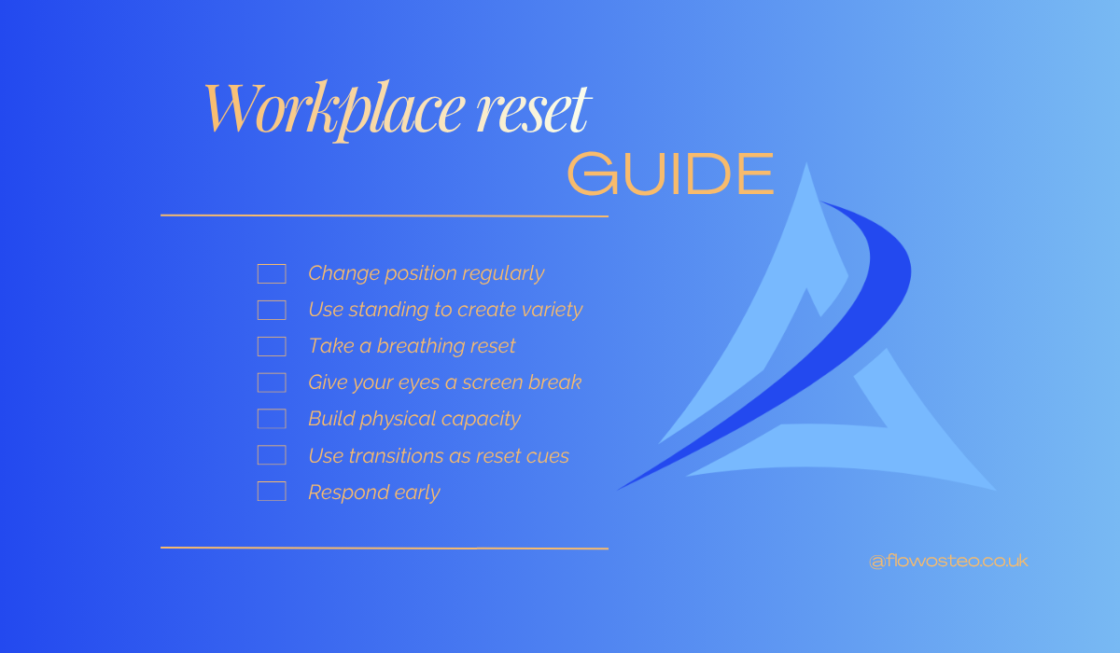
Recommended actions typically include:
- Implementing wellbeing strategies that address both mental health and musculoskeletal risk, supported by visible leadership and clear metrics.
- Investing in ergonomic assessment and workplace adjustments, alongside access to occupational health and MSK‑focused services for staff with emerging or established conditions.
- Training managers to recognise early signs of distress and MSDs and to facilitate timely referral, flexible working, or phased return to work where appropriate.

Within this broader framework, organisations may choose to work with specialist providers, including osteopathic and MSK‑focused services such as FLOW OSTEO to help operationalise these recommendations. In this context, FLOW OSTEO may contribute by offering ergonomic assessments, education on movement and load management, and evidence‑informed manual therapy and recovery strategies where clinically appropriate for employees with MSD‑related symptoms – always as part of a multi‑component occupational health approach rather than as a stand‑alone solution. Based on current evidence, it is appropriate to describe such services as potentially supporting comfort, function, and early management of symptoms, while avoiding over‑specific claims about guaranteed reductions in absence.

Reference
Bryan ML, Bryce AM, Roberts J. The effect of mental and physical health problems on sickness absence. Eur J Health Econ. 2021;22:1519–1533.
Health and Safety Executive. Working Days Lost in Great Britain 2023/24. Published May 2025.
Office for National Statistics. Sickness Absence in the Labour Market 2023–2024. Published June 2025.
CIPD. Health and Wellbeing at Work Report. 2025.
Statista. Days of absence per employee in the UK, 2010–2025.