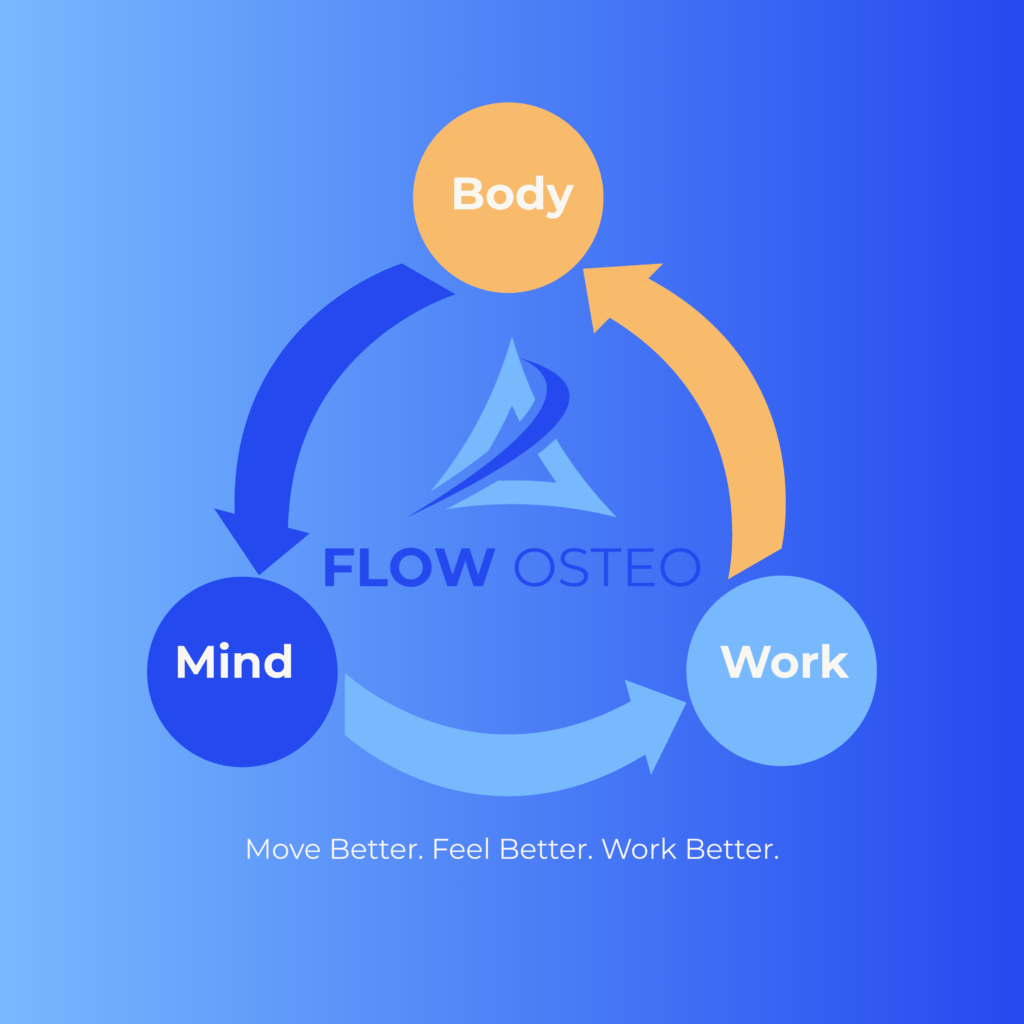
Musculoskeletal pain, stress, and burnout rarely arise from a single cause in UK workplaces today. They typically emerge from a dynamic interaction between the body, the mind, and the environment people work in – the three sides of the FLOW OSTEO triangle. Engel’s biopsychosocial model offers a robust, evidence‑based way to understand this interaction and to design workplace health strategies that are both humane and commercially sensible (Borrell‑Carrió et al., 2004).

Why the biopsychosocial lens matters for SMEs. From symptoms to systems
George Engel originally proposed the biopsychosocial model as an alternative to a narrow biomedical view that treated people as bodies with faults to be fixed (Borrell‑Carrió et al., 2004). Instead of asking only “What is wrong with this spine or shoulder?”, the model asks how biology, psychology, and social context combine to shape how pain appears, persists, and impacts work (Borrell‑Carrió et al., 2004). For SMEs, this shift is important: it legitimises attention not only to posture and ergonomics, but also to workload, leadership style, team culture, and individual meaning‑making around illness and performance (Ventres et al., 2024).
Engel’s systems perspective is grounded in complexity science: small changes in any part of the system – from shift patterns to job security – can, over time, influence mood, pain, sleep, and engagement (Borrell‑Carrió et al., 2004). Rather than searching for one culprit (“the chair”, “the disc”, “the employee’s mindset”), a biopsychosocial approach helps organisations see patterns and feedback loops: how pain restricts movement, reduces confidence, increases absence, and feeds back into stress and further pain (Borrell‑Carrió et al., 2004).

The FLOW triangle: body, mind, environment at work
I translate this model into a simple triangle: body, mind, and environment at FLOW OSTEO. Each side is distinct, but they are inseparable in practice. Bodies bring vulnerabilities, strengths, and histories of injury or illness. Minds bring beliefs, expectations, and emotional responses to pain, workload, and change. Environments – physical, organisational, cultural – shape what is possible and what feels safe or threatened (Ventres et al., 2024; Williamson, 2022).
Research in primary care and musculoskeletal practice shows that when these dimensions are handled in isolation, care tends to revert to reductionism – for example, offering only manual treatment, only exercise, or only “pain education” without adequately engaging with context and meaning (Cormack et al., 2023; van Dijk et al., 2023). An integrated triangle reminds organisations that “nothing structurally wrong” does not mean “nothing real”, and that psychological and social factors are genuine drivers of symptoms, disability, and recovery trajectories, not mere add‑ons (Williamson, 2022; Cormack et al., 2023).
What the evidence tells us about biopsychosocial care
Decades of work in family medicine and primary care suggest that outcomes improve when clinicians move beyond a purely diagnostic mindset and invest in relationships, narrative, and shared sense‑making (Borrell‑Carrió et al., 2004; Ventres et al., 2024). Patients do not simply need a label; they need an explanation that makes sense in their own life, delivered within a relationship that feels safe, respectful, and collaborative (Borrell‑Carrió et al., 2004).
More recent work in musculoskeletal health shows something similar. Cormack and colleagues argue that the biopsychosocial model has sometimes been “lost in translation” – used as rhetoric while practice remains either narrowly biomedical or overly brain‑centred, with insufficient attention to lived experience and environment (Cormack et al., 2023). They propose an “enactive” view, where pain is seen as an emergent property of the whole person–environment system, and where change depends on shifting the opportunities for meaningful action in that system (Cormack et al., 2023). This aligns closely with workplace realities: employees are not passive recipients of treatment but active agents navigating constraints, pressures, and possibilities in real time.
Williamson shows that the biopsychosocial model is philosophically coherent but often marginalised in practice; time pressures and structural incentives favour diagnosis and prescribed treatment over structured, holistic formulation (Williamson, 2022). The parallel in workplace health is clear: it is easy to default to individual “resilience” workshops or quick‑fix interventions while structural drivers – workload, staffing, informal norms – remain unchanged (Williamson, 2022; Ventres et al., 2024).
Physiotherapy research further illustrates the implementation gap. A scoping review by van Dijk and colleagues found that many physiotherapists endorse the biopsychosocial model in principle but deliver care that remains largely biomedical, constrained by training, confidence, time, reimbursement, and perceived patient expectations (van Dijk et al., 2023). Importantly, psychosocial elements are often approached informally or through “gut feeling” rather than structured methods, and clinicians worry about stepping outside their role or damaging the therapeutic alliance if they challenge narrow expectations (van Dijk et al., 2023). These findings are relevant for SMEs considering internal wellbeing initiatives: good intentions are not enough; structure, clarity of role, and organisational support matter.
On a more optimistic note, studies that operationalise biopsychosocial care into defined programmes offer encouraging, if modest, results. Alagappan and Roy report that an eight‑week, structured pain management protocol combining pain neuroscience education, psychological distress management, and self‑management strategies delivered meaningful perceived improvements and high satisfaction in people with chronic musculoskeletal pain, with good acceptability to both patients and therapists (Alagappan & Roy, 2025). Dougherty and Beehler describe a “Joining Forces” model in which chiropractors and behavioural health providers co‑manage chronic low back pain, combining manual therapy, acupuncture, and cognitive‑behavioural approaches within a shared information system (Dougherty & Beehler, 2025). In both cases, effects are described as mild to moderate and the evidence base is still evolving, but they demonstrate that biopsychosocial principles can be translated into deliverable, reproducible interventions (Alagappan & Roy, 2025; Dougherty & Beehler, 2025).
Translating the evidence into workplace practice
For UK SMEs and HR leaders, several practical lessons emerge from this body of work:
- Think systems, not symptoms. Rather than asking only “How do we reduce back pain?”, consider how job design, leadership, culture, and physical setup interact to shape pain, stress, and recovery for your people (Borrell‑Carrió et al., 2004; Ventres et al., 2024).
- Build relationships, not just programmes. Evidence from primary care and musculoskeletal practice highlights the therapeutic value of empathy, trust, and shared interpretation of problems (Borrell‑Carrió et al., 2004; Cormack et al., 2023). In organisational terms, this points towards psychologically safe conversations, skilled line management, and continuity rather than one‑off campaigns.
- Use structure to support holistic thinking. Just as clinical formulations can discipline biopsychosocial reasoning, workplaces benefit from structured approaches to risk assessment and intervention planning that explicitly consider body, mind, and environment, rather than relying on intuition alone (Williamson, 2022; van Dijk et al., 2023).
- Invest in capability, not just awareness. The physiotherapy literature shows that knowledge of the biopsychosocial model does not automatically translate into confident practice; capability, identity, and organisational support all matter (van Dijk et al., 2023). The same applies to managers and wellbeing leads: they need skills, supervision, and clear boundaries, not just information.
- Favour integrated, realistic interventions. Studies such as those by Alagappan and Roy, and by Dougherty and Beehler, suggest value in programmes that integrate education, behaviour change support, and targeted physical or manual therapies, delivered in ways that fit real‑world constraints (Alagappan & Roy, 2025; Dougherty & Beehler, 2025). For SMEs, this might mean partnering with providers who can deliver coherent, staged support rather than isolated services.
FLOW OSTEO’s workplace wellness day is designed with these lessons in mind. The triangle of body, mind, and environment is not a logo; it is a blueprint. In practice, that means combining high‑quality musculoskeletal assessment and treatment with psychologically informed communication, and working alongside leaders to align policies, spaces, and expectations with what we know helps people recover and thrive (Borrell‑Carrió et al., 2004; Ventres et al., 2024).
An invitation to reflective, evidence‑based collaboration
The biopsychosocial literature is clear on two points: first, that health, work, and wellbeing are co‑produced by bodies, minds, and environments; and second, that closing the gap between rhetoric and reality requires deliberate, structured effort at individual, team, and organisational levels (Williamson, 2022; van Dijk et al., 2023; Cormack et al., 2023). For SMEs, this is less about adopting a fashionable model and more about cultivating a way of seeing – and acting on – the everyday conditions that shape musculoskeletal health, performance, and retention.
If you are a business owner, HR professional, or decision‑maker who recognises these dynamics in your own organisation, FLOW OSTEO would welcome a conversation. Together, we can explore how an evidence‑based, human‑centred biopsychosocial approach – grounded in your people’s lived realities and your commercial priorities – might help your workplace move beyond managing pain to enabling sustainable, healthier ways of working.
References
Alagappan TR, Roy ST. Implementation outcomes of a biopsychosocial model pain management protocol in chronic musculoskeletal pain. J Educ Health Promot. 2025;14:493.
Borrell‑Carrió F, Suchman AL, Epstein RM. The biopsychosocial model 25 years later: principles, practice, and scientific inquiry. Ann Fam Med. 2004;2(6):576–582.
Cormack B, Stilwell P, Coninx S, Gibson J. The biopsychosocial model is lost in translation: from misrepresentation to an enactive modernization. Physiother Theory Pract. 2023;39(11):2273–2288.
van Dijk H, Köke AJA, Elbers S, et al. Physiotherapists using the biopsychosocial model for chronic pain: barriers and facilitators—a scoping review. Int J Environ Res Public Health. 2023;20:1634.
Dougherty P, Beehler G. Biopsychosocial management of chronic lower back pain: the role of manual therapy and behavioral health co‑management. Front Musculoskelet Disord. 2025;3:1646096. doi:10.3389/fmscd.2025.1646096.
Ventres WB, Stone LA, Shah R, et al. Storylines of family medicine II: foundational building blocks—context, community and health. Fam Med Community Health. 2024;12:e002789.
Williamson S. The biopsychosocial model: not dead, but in need of revival. BJPsych Bull. 2022;46:232–234